Code, commits, and tests show what exists and what changed. They rarely preserve why one approach won, which failure should not be retried, or what an incident taught the team.
2
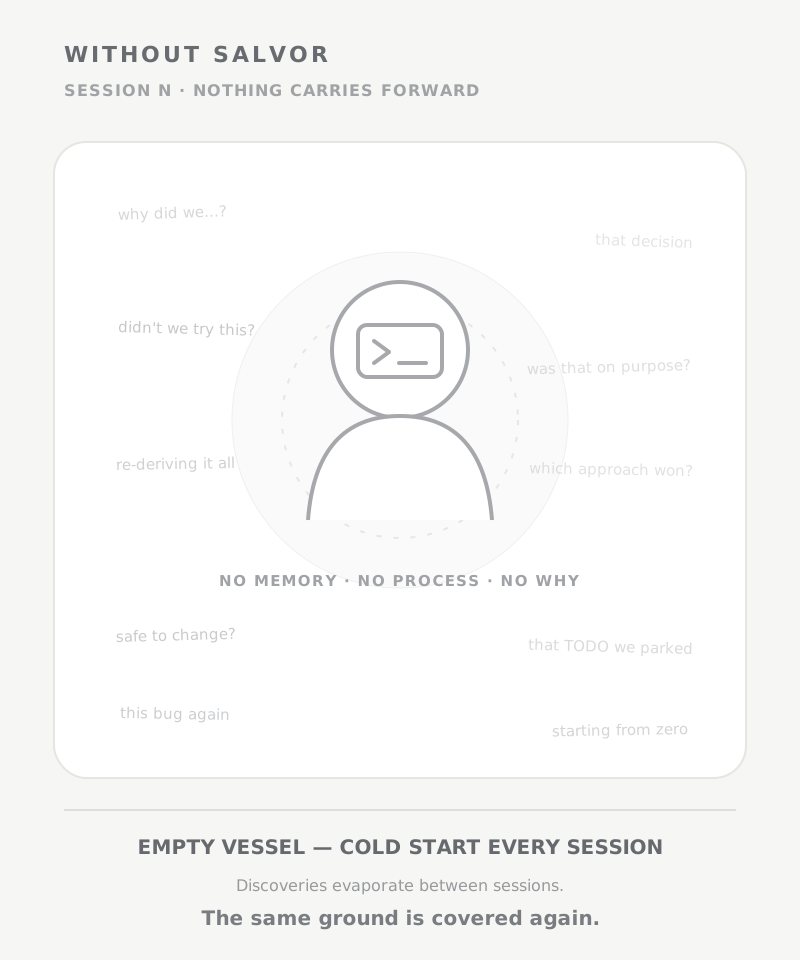
Fresh sessions often reconstruct the same context.
Context rotation, subagents, handoffs, parallel branches, new contributors, and vendor changes each create another chance to rediscover, re-litigate, or quietly lose hard-won engineering knowledge.
3
Salvor preserves what the project learned.
Salvor gives decisions, rationale, domain learnings, rejected approaches, operational lessons, SOPs, and deferred findings a durable, reviewable home alongside the source they explain.
// SALVOR'S ANSWER
Agents can remember. Salvor makes the important knowledge belong to the repo.
The repo-owned engineering knowledge layer.
Selected decisions, rationale, failures, constraints, and deferred findings become durable Markdown in Git: reviewable with the code, available to teammates, and independent of one vendor workspace.
Persistent engineering cognition is Salvor's term for that durable, governed knowledge carrying forward across sessions, contributors, branches, and models.
Repo-owned
Knowledge travels with the code instead of depending on one agent's memory or one vendor's Project.
Governed
Promotion requires explicit approval; canonical ownership, provenance, contradiction handling, and supersession are defined.
Portable
Supported agents and vendor-native project workspaces can consume the same reviewed repository knowledge.
Git preserves what changed. Salvor preserves what the project learned. Salvor externalizes project cognition; it does not modify an agent's intrinsic intelligence.
// HOW SALVOR WORKS
Hub, Spokes & Adapters
A vendor-agnostic canonical hub holds project-wide context; component spokes keep it focused, while thin multi-vendor adapters route supported agents to the same shared brain.
Two-Tier Memory
L1 is a concise current-state cache. L2 preserves deep reasoning and recovery history.
The shared brain is repo-owned Markdown. Compatible thin adapters let you switch supported vendors without migrating project knowledge.
Governed, Versioned Why
RULES.md defines how reviewed project knowledge and component context stay synchronized. Optional Strict defaults can also enforce project-specific version counters and parity rules.
Serena + GitNexus
Optional code intelligence: navigate by symbol and analyze impact before editing.
.salvor/ is the namespaced brain: L1/L2 state, DOMAIN_REF.md, infrastructure, deferred findings (DEFERRED_TODOS.md), postmortems, .salvor/domain-learnings/, and .salvor/decisions/ for durable design rationale. Every durable capture receives a self-allocating slug ID (like LF:stale-note-reference) and structured Subject/Claim metadata. At branch boundaries, the protocol requires knowledge to be compared by subject; duplicates and contradictions are surfaced for your decision, never shipped silently.
The protocol calls for Brain Reconcile at merge and pull points, and for a recurring Brain Audit of the reviewed knowledge layer for stale, duplicate, overlapping, or contradictory claims.
Every capture class is user-gated — durable saves need your explicit approval. For a finding, the agent asks: Save this as a domain learning? (yes/no) An experimental, off-by-default mode additionally lets agents capture provisionally for overnight and multi-agent runs — explicitly flagged, held in a lower trust tier, and ratified item-by-item by you.
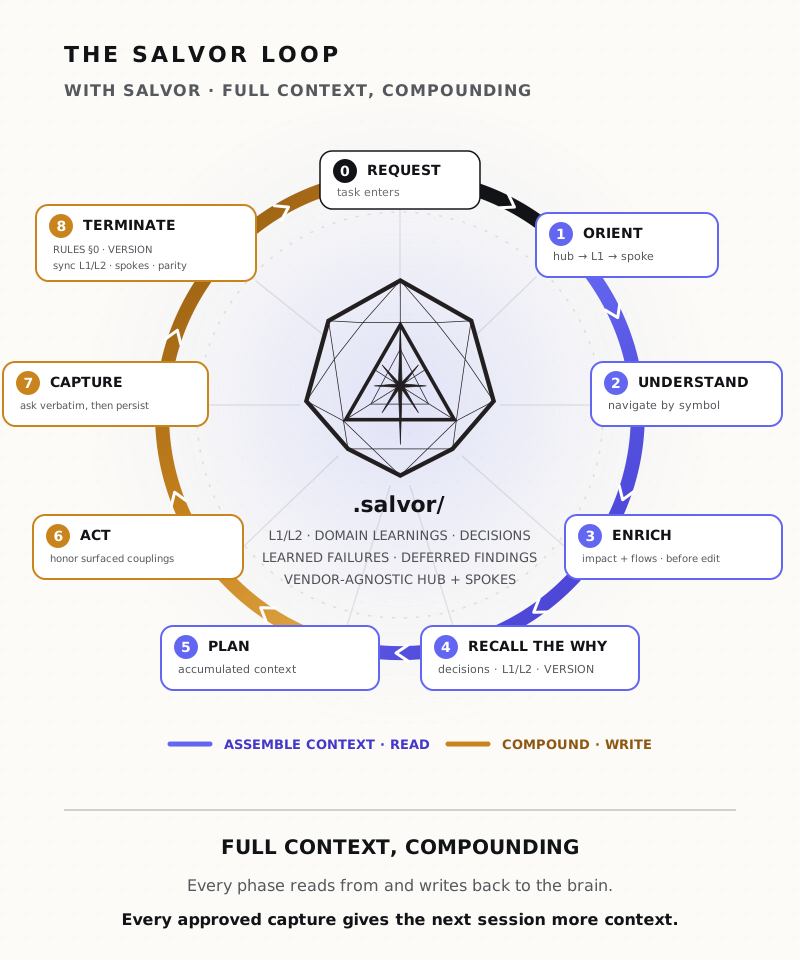
// THE SALVOR LOOP
Every approved capture gives the next session more context.
The shared brain supplies context before the work, then receives user-approved knowledge and rationale after it — so a fresh session can start from reviewed knowledge instead of reconstructing it from scratch.
This is what the brain looks like after real work — every file reviewed in Git. View a populated example →
// SALVOR COMPOUNDS
GREENFIELD
Grow the brain with the code.
Architecture decisions, implementation choices, failures, operating procedures, and domain discoveries accumulate as the project develops.
MATURE + DELIBERATE
Map what the team already knows.
Committed docs, ADRs, changelogs, postmortems, runbooks, and project instructions can seed reviewed knowledge through section-level mappings.
MATURE + MINIMAL
Start thin and learn forward.
Salvor begins with what setup can legitimately derive from available project state. Undocumented historical rationale remains undocumented until evidence surfaces.
Structure can often be derived. Rationale needs evidence.
Existing sources are inspected read-only. Salvor proposes mappings, preserves canonical ownership, and asks before promotion or mutation; it cannot preserve knowledge it has never been given or had a chance to learn.
// USE SALVOR
>_
Paste the prompt in any supported agent
PRIMARY PATH
Vendor-agnostic and vendor-portable out of the box: a repository-owned canonical hub and focused component spokes hold the shared context. Thin entrypoint adapters for Claude Code, Codex, and GEMINI.md-compatible clients route each supported agent to that same brain; other agents can integrate through compatible thin adapters.
Open a supported coding agent at the repository root.
Paste SETUP_PROMPT.md and answer the four setup questions.
For an existing project, review a read-only inventory and optionally adopt selected docs or knowledge during setup—or later on demand—through the same section-level mapping flow. Originals remain untouched unless you separately approve changing them.
Review the proposed files and the completed diff.
Enable Serena and GitNexus if desired. They are optional and recommended when you want semantic symbol navigation and graph-based impact analysis; review each project's installation and license terms first.
When GitNexus is selected, let setup detect the installed CLI's capabilities and offer the safest supported indexing mode.
Review and optionally commit only the Salvor-related changes.
Core works with repository files alone; setup doesn't fail without the optional enhanced integrations. Upgrading later is the same move: paste a newer SETUP_PROMPT.md and setup reads the install's protocol stamp, proposing only the protocol deltas. The process is designed to preserve accumulated project knowledge; any explicit identifier, header, link, or metadata migration is proposed separately for approval.
$ cat SETUP_PROMPT.md
$ # copy the output; paste into your CLI
$ # answer the setup questions
$ # Salvor scaffolds the rest
Three inspectable examples show project knowledge surviving into later work. They are operational evidence, not an independent benchmark or a universal performance claim.
TRIGGER→CAPTURE→COMPOUNDED KNOWLEDGE
Each example follows the same path: engineering work triggers a durable capture; later sessions inherit the reviewed result.
DESIGN DECISION
TRIGGER: INCIDENT
Branch flow inverted
CAPTURED
The dev-first release SOP and the rationale behind it.
COMPOUNDED KNOWLEDGE
Later sessions begin from the corrected policy instead of reconstructing the incident.
DESIGN DECISION
TRIGGER: RISK
Mature-repo adoption
CAPTURED
A preservation-first invariant: reuse existing hubs, rules, tool state, and docs.
COMPOUNDED KNOWLEDGE
Setup presents an adoption map before any approved promotion or mutation.
DOMAIN LEARNING
TRIGGER: VERSION DRIFT
GitNexus capabilities varied
CAPTURED
A tested index-only default and a boundary for machine-derived structure.
COMPOUNDED KNOWLEDGE
Derived code intelligence does not silently rewrite canonical project knowledge.
Salvor is designed around engineering knowledge that compounds across real project history: decisions, domain learning, failed approaches, and deferred findings reused by later sessions and contributors.
Long-horizon agent-memory evaluation is advancing quickly. The methods reviewed cover important adjacent settings, including coding and multi-session reliability, but do not directly reproduce this full mature-repository, repository-governed construct.
As suitable coding-oriented longitudinal evaluation methods mature, we will publish reproducible results here.
Earlier exploratory short-horizon experiments remain archived for reproducibility, but they are not treated as longitudinal validation of Salvor.
// CODE INTELLIGENCE INTEGRATIONS
Salvor's core runs on repository files alone. Serena MCP and GitNexus MCP are optional integrations for semantic code navigation and graph-based impact analysis, each under its own license and terms.
Optional integration providing a code knowledge graph to inspect the likely blast radius before editing or shipping. A third-party project under the PolyForm Noncommercial license; review its terms for your use.